‘善有善报。’
“Repay good with good.”
-Chinese Proverb
Introduction
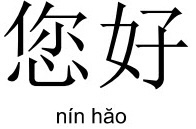
您好!You’re not sure what that means? It’s the formal or polite way to say hello. In Pinyin it is spelled nínhǎo. If you haven’t guessed yet, in this post we will go over ‘Hello’ formal and casual. We will also go over Goodbye, and Good morning.
As I said in the introduction post on this website, Hello is the first Chinese word I ever learned. From age thirteen to age seventeen I frequented a game site, Kongregate. If anyones ever heard of it you may remember that it had a chat box on the side of whichever game you were playing. I frequented the Chinese chat room and became insanely interested in the symbols, so at fourteen or fifteen I learned how to write nǐhǎo. That’s about as far as I got though. Fast forward twelve years later, I’m twenty-seven years old and I’m finally taking a shot at learning the rest. So let’s begin with nínhǎo!【您好】。
Hello (Formal)
nínhǎo,【您好】,Hello (formal)
nínhǎo
There are two ways to say ‘Hello’ in Mandarin. One phrase is formal and the other, casual.
The first version of ‘Hello’ I will go over with you is the formal version, or nínhǎo【您好】。
You would use 您好 when speaking to somebody substantially older than you, such as a young child to an adult or an adult\young adult to an elder.
If somebody in a customer service position were to speak to their customers/clients, then 您好 【nìnhǎo】would come across as more polite than 你好,【nǐhǎo】。
We will go over nǐhǎo in the next section of this post. For the time being, directly below is a YouTube Short of how to write nínhǎo【您好】。
Hello (Casual)
The second way to say ‘Hello’ in Mandarin is written in Pinyin as nǐhǎo. 【你好】。
你好 is the more casual way to say Hello. It’s for when you’re speaking to someone your own age that you know well, a friend, cousin, brother or a sister.
You’ll find a video on how to write nǐhǎo below.
Goodbye (Normal)
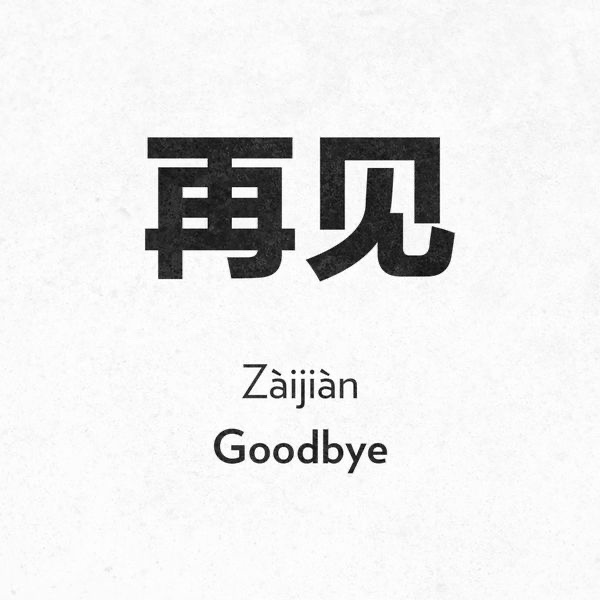
zàijiàn,【再见】,Goodbye
z-à-i-j-i-à-n
There are also two forms of goodbye. The one we’ll be speaking of in this section translates to ‘Goodbye’
In Pinyin we would write goodbye as ‘zàijiàn’【再见】and as I said up above, zàijiàn’s literal translation is ‘Goodbye’
Below is a video on how to speak and write 再见。
Goodbye [Bye bye!]
The other form of ‘Goodbye’ is more common among younger persons. It’s literal translation is “Bye bye!” And it sounds exactly like that when written out in Mandarin.
The Pinyin version of ‘Bye bye!’ In Mandarin is báibái. 【拜拜】。 and it is a very simple one to write and speak. There is a video on how to speak and write it below.
Good Morning
zǎoshànghǎo,【早上好】,Good Morning

z-ǎ-o -s-h-à-n-g–h-ǎ-o
The word good is used in quite a few phrases and obvious enough ‘Good Morning’ is one of them.
What is the symbol and Pinyin for good you ask? Well, we’ve already been over it I just didn’t tell you.
Good is used in ‘Hello’ along with nǐ and it is also used in the formal ‘Hello’ along with nín. hǎo【好】means good.
When I give you the symbol for morning, you should know how to write and speak ‘Good morning’. As long as you remember that the ‘good’ comes after morning, so the literal translation for ‘Good morning’ is ‘Morning good’ but when going from Chinese to English it’s translated to ‘Good Morning’
Morning in pinyin is written as zǎoshànghǎi,【早上好】
Below is a video on how to write 早上好。
Outro
So let’s review, here’s a list of what we’ve started to learn.
- Hello, Formal. (For speaking. To elders, superiors, teachers or parents for children, etc.
- In Pinyin the formal ‘Hello’ read as nìnhǎo, the symbols for nìnhǎo are 您 and 好。 together forming 您好。
- Hello, casual. For speaking to friends or people you know well.
- In pinyin it reads as nǐhǎo, the symbols for nǐHǎo are 你 and 好。 together forming.m 你好。
- Goodbye when speaking of the literal phrase ‘goodbye’
- In Pinyin ‘Goodbye’ reads as zàijiàn, the symbols for it being 再 and 见。 forming 再见。
- Bye bye!
- When younger folk are speaking to one another they will most likely say ‘bye bye!’. Or, in Pinyin, báibái。
- Last review point is Good and morning. Good had already been used before I brought it up. like I mentioned above, it is used in Hello and a few other phrases that we’ll cover shortly.
- In Pinyin ‘Good’ reads as hǎo, which is 好。
- In Pinyin, morning reads as zǎoshàng and the symbols are 早上。
- So, in pinyin, ‘Good morning‘ reads as zǎoshàngbǎo。 A.K.A. 早上好。
 The World Is Ending and Hank Moody is Teaching Chinese!